
WHAT ELSE!
By Nazli Kok Akbas
When Constantin Brancusi’s Danaide sold for more than $107 million at Christie’s New York in May 2026, it became far more than another record-breaking auction. It marked a new chapter in the way masterpieces are presented to the world, where art, cinema, celebrity, and mythology merge into a single cultural narrative.
Rather than relying solely on scholarship and provenance, Christie’s created an unforgettable campaign starring Academy Award-winning actress Nicole Kidman. Long before the auctioneer’s hammer fell, Danaide had already become one of the most talked-about artworks of the season. The campaign transformed Brancusi’s iconic sculpture into a global cultural image, demonstrating that today’s great auctions are as much about storytelling as they are about selling.
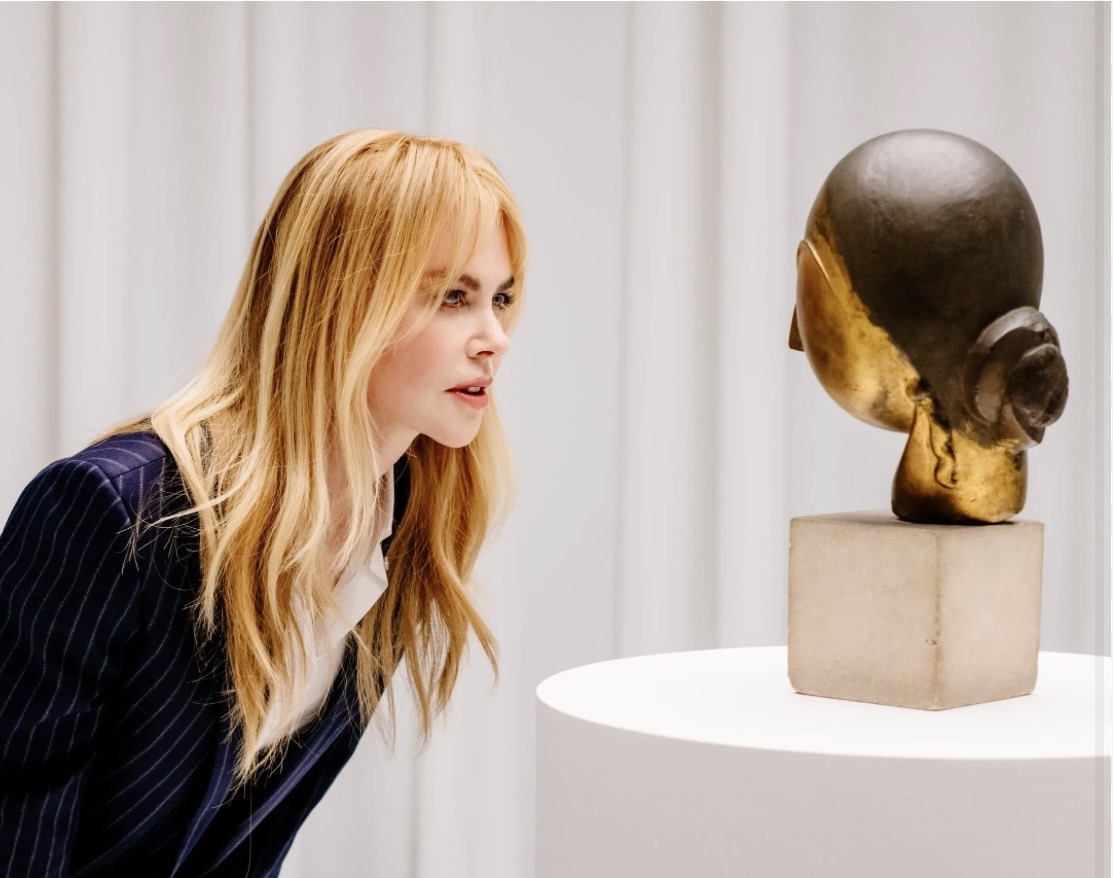
Created around 1913, Danaide draws its inspiration from Greek mythology. The sculpture takes its name from the fifty daughters of King Danaus, who were forced to marry the sons of his rival, Aegyptus. Ordered by their father to murder their husbands on their wedding night, all but one obeyed. As punishment, the Danaides were condemned to spend eternity carrying water in leaking vessels that could never be filled. Over time, their story became a powerful symbol of endless repetition, unattainable desire, and humanity’s perpetual search for fulfillment.
Brancusi chose not to illustrate the myth literally. Instead, he reduced the female head to a beautifully simplified bronze form whose smooth, elongated curves evoke introspection, melancholy, and timeless serenity. It represents a pivotal moment in the Romanian sculptor’s career, when he abandoned academic realism in favour of pure abstraction, searching not for the appearance of his subjects but for what he famously called their “inner reality.”
The sculpture also reflects Brancusi’s fascination with universal archetypes. Rather than portraying an individual woman, Danaide becomes a meditation on femininity, memory, and destiny. Its elegant oval form foreshadows later masterpieces such as Sleeping Muse and The Newborn, works that would forever redefine modern sculpture.
Christie’s brilliantly understood the symbolic richness of this masterpiece. By placing Nicole Kidman beside the sculpture in a dreamlike cinematic film, the auction house revived the ancient concept of the muse for a contemporary audience. The result blurred the boundaries between modern art, Hollywood glamour, luxury branding, and mythology.

More than an advertisement, the campaign resembled a beautifully crafted fashion film or short cinematic experience. It elevated Danaide beyond the status of an auction lot and transformed it into the protagonist of a modern myth.
Whoever acquired the sculpture purchased far more than an exceptional Brancusi bronze. They acquired an artwork wrapped in centuries of mythology, modernist innovation, celebrity culture, and the timeless human desire for cultural immortality.
The market responded accordingly. Selling for approximately $107.6 million, Danaide became one of the most expensive sculptures ever sold and established a new auction record for Brancusi. The work came from the celebrated collection of media magnate S.I. Newhouse Jr., who had himself purchased it for a record $18.2 million in 2002.
On the same evening, Jackson Pollock’s monumental Number 7A (1948) achieved over $181 million, helping Christie’s surpass $1.1 billion in total evening sales.

The message was unmistakable: today’s greatest works of art are no longer sold through rarity alone. They are presented as complete cultural experiences, where mythology, history, cinema, and emotion become inseparable.
What else?