
By Maria May
There is a large framed Memento Mori hanging in Nadja Skaljic’s office. The ancient reminder that life is finite sits in plain view, not as decoration, but as discipline. It keeps ambition and ego in check while directing attention toward what actually matters.

For someone who has spent her career navigating international law, European policy, finance and sustainability, that kind of clarity is not incidental. It is the method.
We meet at the headquarters of Mover Plastic-Free Sportswear, a Swiss brand that has become one of the more compelling examples of regenerative thinking in practice. The setting suits Nadja Skaljic well. More than most people operating at the intersection of business and environmental policy, she has spent years asking not how systems can be made slightly more efficient, but whether they were designed correctly in the first place.
“The issue was never effort,” she says. “It was architecture.”
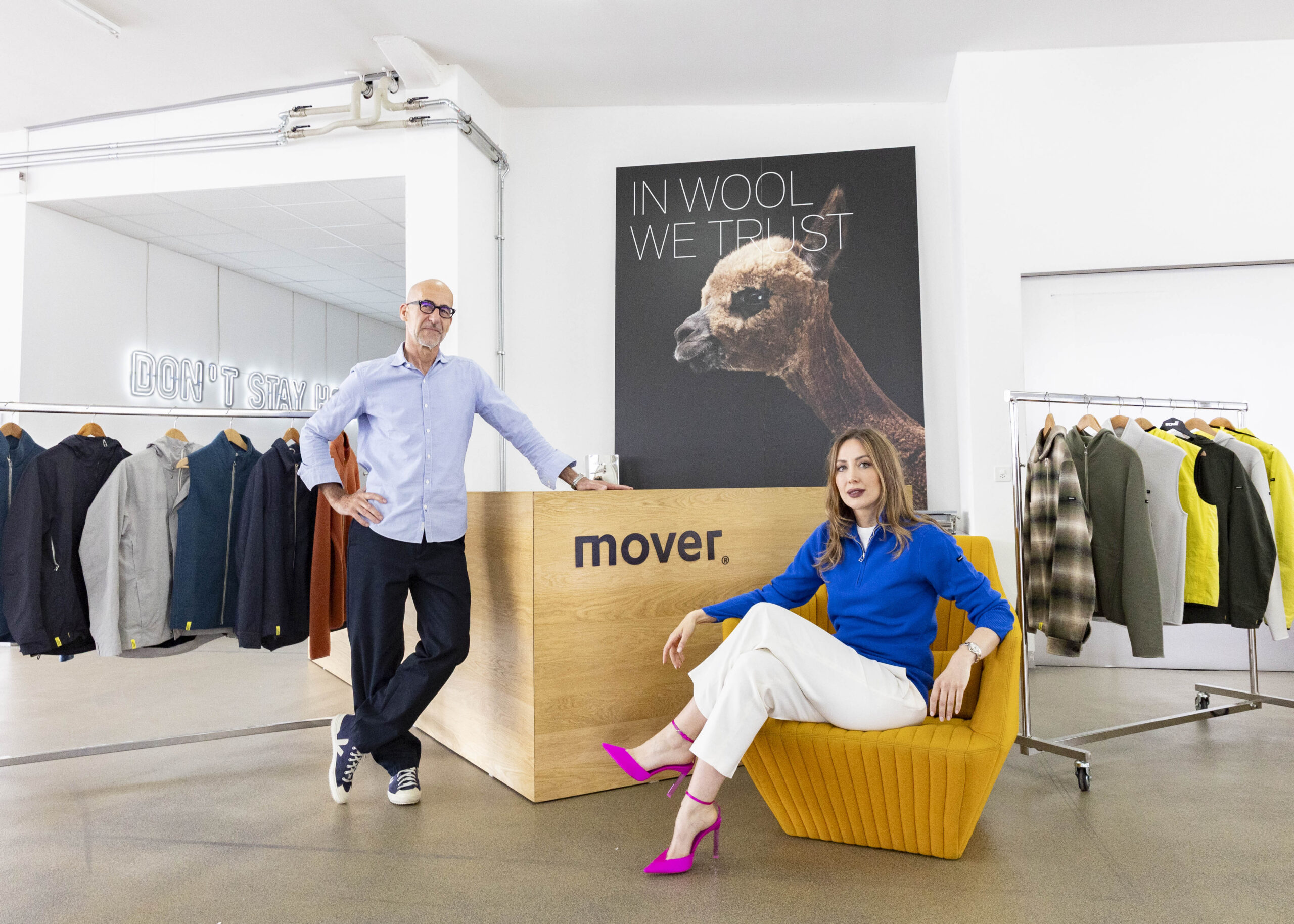
Nadja Skaljic grew up with a clear-eyed understanding that stability is constructed, not inherited. Systems shift. What appears permanent rarely is. That awareness shaped the questions she would spend her career asking.
Working across governments, European institutions and the private sector, she kept observing the same pattern: intelligent people with genuine intentions, working hard, yet meaningful progress remaining stubbornly slow. The bottleneck was rarely knowledge or willpower. It was the invisible infrastructure of incentives, laws and institutions that quietly determined how everyone operated.

That insight changed her approach entirely.
“You can optimise a machine indefinitely,” she says, “or you can ask whether you built the right machine.”
Standing later at the edge of Lake Geneva, looking out toward the Alps, she puts it another way. The water looks timeless. Serene. Untouched. And yet, as she notes without drama, we know microplastics are present beneath the surface. “Just because we don’t see them doesn’t mean they aren’t there.” The most consequential problems, she has learned, tend to be the ones hiding in plain sight.

Mover was founded by Nicolas Rochat not primarily as a sustainability project, but as a performance one. His team discovered that natural fibres, particularly merino wool, frequently outperformed synthetic alternatives in breathability, thermal regulation and comfort. The environmental case followed from the engineering case. Sustainability became the consequence of better design rather than a marketing objective.
For Nadja Skaljic, that distinction is exactly the point.
“The difference between less harmful and regenerative comes down to direction,” she explains. “Less harmful still accepts extraction as the starting point. Regenerative thinking asks how a business can actively improve the systems it depends on.”
It is a subtle shift in language and a profound shift in mindset. Much of the sustainability agenda today focuses on reducing harm: lower emissions, better recycling, greater efficiency. Those efforts remain essential. But Nadja Skaljic believes they represent only part of the answer.

“If the underlying system stays the same,” she says, “efficiency eventually reaches its limits.”
Regeneration begins by asking different questions.
Can products be designed differently from the very beginning? Can businesses create value while restoring ecosystems rather than gradually depleting them? Can innovation improve the health of the natural systems on which every economy ultimately depends?
These questions are becoming more urgent as artificial intelligence, digital infrastructure and data centres rapidly increase demand for energy, land and natural resources. For Nadja Skaljic, the challenge is not technological progress itself. Innovation has never moved faster. The real challenge is ensuring that the systems supporting this progress evolve at the same pace.
She believes Switzerland is well positioned to lead that conversation. The country has built an international reputation for precision engineering, scientific rigour and institutional trust. The next opportunity, she argues, is applying those same strengths to the design of entire systems, not just products.
“Switzerland doesn’t lack capability,” she says. “The challenge is pace.”
Despite the scale of the problems she works on daily, Nadja Skaljic is not pessimistic. She finds that many of the technologies and scientific breakthroughs needed already exist. What remains scarce is alignment: between institutions, incentives and political will.
Outside her professional work, she paints, collects art and serves on the boards of companies working in biotechnology and brain-computer interfaces. She escapes to the Alps or the ocean when she can. She describes those conversations with artists, engineers, farmers and entrepreneurs as essential, not supplementary. Different perspectives, she says, are where better questions come from.
The Memento Mori on her office wall, it turns out, is less about mortality than about focus. A reminder that time is finite sharpens the mind wonderfully. It clarifies which problems are worth solving and at what speed.
Leaving Mover’s headquarters that afternoon, one thought stays with me.
Regeneration is not another environ-mental buzzword. It is a different framework for thinking about progress entirely: one that asks not how we can do less harm, but how we can design businesses, technologies and institu-tions that actively restore the systems on which life depends.
The most important changes, as Nadja Skaljic would say, are often the ones you cannot see yet. The work is to build the conditions for them to become visible.
Photo credit: David Serkin
For more about Nadja’s work visit: Website: www.nadjaskaljic.com
Mover Sportswear
Website: www.mover.eu
Instagram: @moversportswear_official




Leave A Comment